Encyclopaedia Cosmopolis, 12th Edition (2150)
Overview
The Canton of Wales is one of the five Cantons within the United Kingdom Global Senate Constituency. Although culturally distinct and politically autonomous at the cantonal level, Wales does not possess its own representation in the Global Senate. Instead, its population participates in the UK Electoral College, which selects the Constituency’s four Senators by consensus.
With a population of approximately 4.2 million in 2150, Wales represents around 6.3% of the UK Constituency’s total population (~67 million). This gives the Canton a meaningful but limited influence in the selection of the UK’s global delegation.
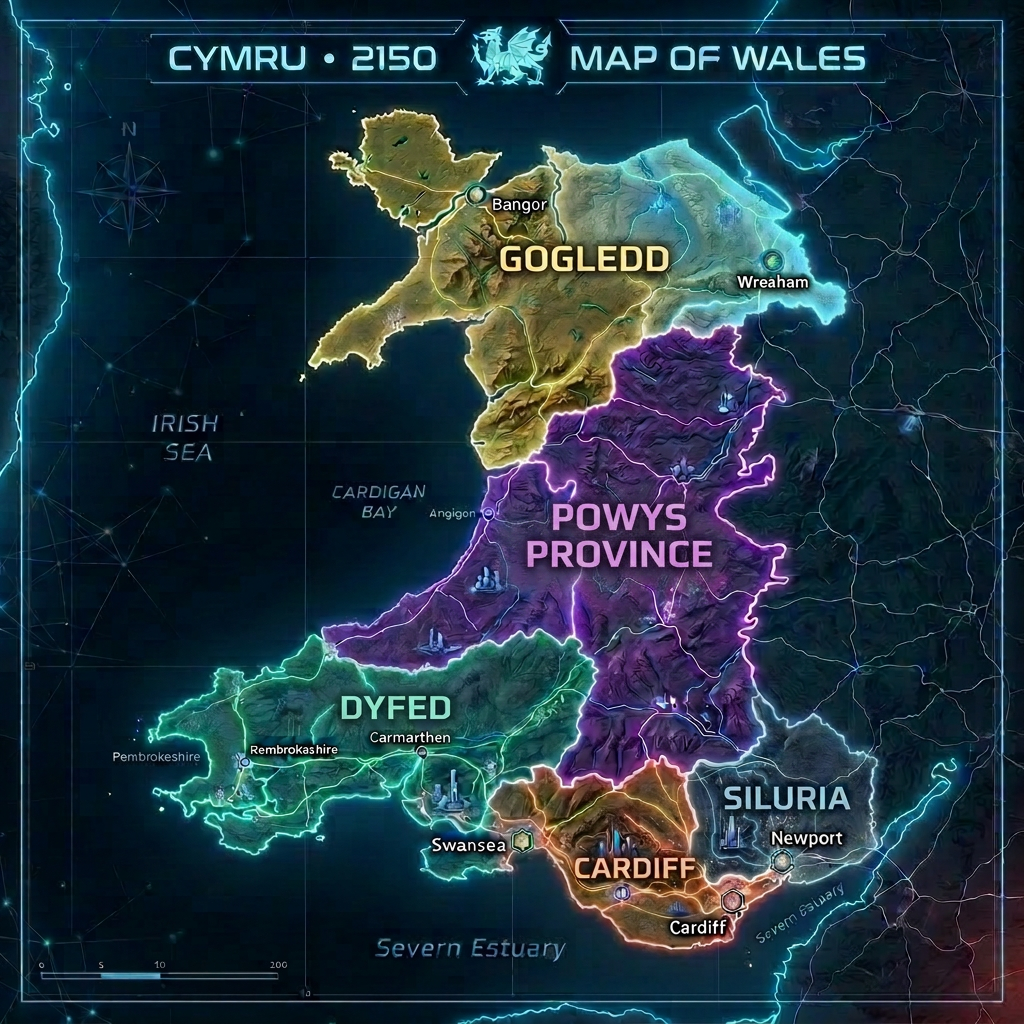
Wales is divided into five provinces—Caerdydd, Gogledd, Dyfed, Powys, and Siluria—each with its own micro‑charter, cultural identity, and devolved administrative structures. These provinces cooperate through the Senedd, the Canton’s unicameral legislature, which includes a standing Inter‑Provincial Committee responsible for harmonising energy, transport, and cultural policy.
Constitutional Status
Wales is a sovereign Canton under the Constitution of the Cybernetic Mosaic. It possesses full authority over:
- cultural preservation and linguistic policy
- settlement rules and migration decisions
- education and heritage
- land use and environmental stewardship
- internal law and social pace
- inter‑cantonal and inter‑city foreign relations
Wales does not conduct diplomacy at the global tier (reserved for the Global Senate), but it does maintain a structured foreign policy toward:
- neighbouring Cantons (Wessex, Mercia, Northumbria, Scotland)
- the Free Cities of the UK Constituency (GEC, WMC, LTC)
- the All‑Ireland Constituency, especially:
- the Dublin Conurbation (DC)
- the Ulster Canton (UC)
These relationships are central to Wales’s economic and cultural orientation.
The Senedd
The Senedd is the Canton’s legislative and deliberative body. It includes:
- Provincial Delegates elected from each province
- Civic Representatives chosen by sortition
- Cultural Stewards appointed by linguistic and heritage institutions
The Senedd oversees:
- Canton‑wide legislation
- inter‑provincial coordination
- settlement rules
- the Canton’s foreign relations
- contributions to the Stabilization Fund
- oversight of paramilitary police forces
Standing Inter‑Provincial Committee
This committee ensures policy coherence across the five provinces, particularly in:
- energy grid harmonisation
- ecological protection
- transport integration
- cultural continuity
It is widely regarded as one of the most effective sub‑national governance bodies in the North Atlantic Arc.
Energy Independence
Wales achieved full energy independence in 2098 and is a net exporter of renewable energy. Its system is based on:
Wind Power
- Offshore arrays in the Celtic and Irish Seas
- Onshore turbines in upland zones
- Community‑owned cooperatives in Dyfed and Powys
Hydro‑Electric Systems
- Micro‑hydro installations along upland rivers
- Pumped‑storage facilities in Snowdonia and the Brecon Beacons
- Tidal‑flow turbines in the Menai Strait and Severn Estuary
Hydrogen Storage and Export
- Green hydrogen for winter balancing
- Hydrogen‑powered coastal transport
- Export terminals in Siluria and Caerdydd
Energy policy is decentralised but coordinated through the Senedd’s Energy Commons Charter, which mandates ecological sustainability and local ownership.
The Five Provinces of Wales
Each province is effectively a city‑state cluster, with its own cultural character and governance style.
1. Caerdydd Province
Capital: Caerdydd/Cardiff Character: Urban‑civic, bilingual, cultural‑administrative hub
Caerdydd Province houses:
- the Senedd,
- the National Cultural Archives,
- the Welsh Language Innovation Institute,
- and the Canton’s diplomatic offices for inter‑cantonal and inter‑city relations.
It maintains especially close ties with the London–Thames Conurbation (LTC) and the Dublin Conurbation (DC).
2. Gogledd Province
Capital: Bangor Character: Mountain‑maritime, Welsh‑revivalist, eco‑frontier
Gogledd is the Canton’s linguistic stronghold, with the highest proportion of Welsh‑dominant households. It is known for:
- its Snowdonian uplands,
- its coastal communities,
- its leadership in tidal‑energy systems,
- and its strong cultural institutions supporting Welsh literature and education.
Gogledd maintains deep economic and cultural ties with the All‑Ireland Constituency, especially the Ulster Canton (UC) and the Dublin Conurbation (DC), facilitated by high‑speed maritime links.
3. Dyfed Province
Capital: Carmarthen Character: Agrarian‑coastal, mythic‑pastoral, community‑owned economy
Dyfed is the Canton’s agricultural heartland, known for:
- community land trusts,
- organic agricultural cooperatives,
- and a strong mythic identity rooted in Mabinogion traditions.
It maintains close cultural and economic ties with Munster Canton and the western regions of the All‑Ireland Constituency.
4. Powys Province
Capital: Newtown Character: Upland‑frontier, dispersed‑settlement, hydro‑industrial
Powys is sparsely populated but technologically advanced. It is the Canton’s powerhouse for:
- pumped‑storage hydroelectricity,
- upland wind farms,
- and forest‑integrated eco‑settlements.
Its micro‑municipalities are known for radical local democracy.
5. Siluria Province
Capital: Newport Character: Borderland‑cosmopolitan, post‑industrial‑renewed, cultural‑hybrid
Siluria is the Canton’s most cosmopolitan province and its primary export hub for hydrogen and renewable energy. It is known for:
- post‑industrial green corridors,
- river‑port hydrogen terminals,
- and the distinctive Silurian dialect of Welsh.
Siluria maintains the closest ties to the Free Cities, especially LTC.
Inter‑Provincial and External Relations
Wales’s political culture is shaped by a balance of:
Internal Cooperation
- Caerdydd leads cultural and administrative coordination.
- Gogledd and Dyfed anchor linguistic and heritage revival.
- Powys provides energy stability.
- Siluria handles export logistics and inter‑city diplomacy.
External Relations
Wales maintains structured agreements with:
- All‑Ireland Constituency (energy, culture, maritime transport)
- LTC, WMC, GEC (economic and mobility arrangements)
- Wessex, Mercia, Northumbria, Scotland (heritage, ecology, and transport corridors)
These agreements are negotiated by the Senedd’s Office for Inter‑Cantonal Relations.
Identity and Global Role
Wales is widely regarded as:
- a leader in cultural preservation,
- a pioneer in renewable energy,
- a model of democratic localism,
- and a bridge between traditionalist Cantons and cosmopolitan Free Cities.
Its political future remains a subject of debate, particularly regarding whether it should become a Global Senate Constituency in its own right.
Speculative Urban Futures: The South Wales Conurbation (Cyd‑Drefi De Cymru)
Projected Development Debate, 2150–2200
By the mid‑22nd century, a growing body of urbanists, planners, and political theorists within Wales Canton have begun to discuss the possibility of a future Free City emerging along the southern coastal belt. This proposed megacity is commonly referred to as the:
Cyd‑Drefi De Cymru
(South Wales Conurbation)
The term has entered both academic and popular discourse, though no formal proposal has yet been submitted to the Senedd.
Rationale Behind the Proposal
1. Economic Integration
By 2150, the economic corridors between:
- Swansea (in Dyfed)
- Cardiff (Caerdydd Province)
- Newport and the Wye–Usk corridor (Siluria)
have become deeply interlinked through:
- hydrogen‑powered rapid transit,
- shared industrial‑ecological infrastructure,
- cross‑provincial labour markets,
- and joint research clusters in robotics, biocybernetics, and environmental engineering.
2. Demographic Gravity
The three cities collectively form the largest continuous population zone in Wales Canton, with:
- high‑density urban districts,
- shared commuter belts,
- and overlapping cultural spheres.
3. Free City Eligibility
Under the Cybernetic Mosaic’s constitutional architecture, a region may petition to become a Free City if it demonstrates:
- economic self‑sufficiency,
- cosmopolitan demographic patterns,
- high‑density urbanisation,
- and the capacity to operate the dual‑key settlement system.
By 2150, Cyd‑Drefi De Cymru meets many of these criteria.
Political Implications
1. Canton Restructuring
If the South Wales Conurbation were recognised as a Free City by 2200:
- Cardiff would cease to be the administrative capital of Wales Canton.
- Bangor — already the cultural and linguistic anchor of Gogledd — would likely become the de facto capital of the remaining Canton.
- The Canton would shrink territorially but gain a clearer cultural and linguistic identity.
2. Provincial Rebalancing
The removal of Cardiff, Newport, and Swansea from the Canton’s internal structure would:
- strengthen the rural and upland provinces (Gogledd, Powys, Dyfed),
- consolidate Siluria’s identity as a borderland‑cosmopolitan region,
- and shift the Canton’s political centre of gravity northwards.
3. Relationship with the UK Constituency
A new Free City in South Wales would join:
- LTC,
- WMC,
- GEC,
as a fourth Free City within the UK Constituency — a significant development in the region’s political geometry.
Cultural and Linguistic Considerations
Supporters argue that:
- A Free City would allow the southern urban belt to embrace its cosmopolitan, high‑velocity identity.
- The remaining Canton would become more cohesive, with Welsh language usage even higher than the current 70% average.
- Bangor, as a historic centre of Welsh scholarship, would be a natural capital.
Opponents counter that:
- The Canton’s unity would be weakened.
- The Senedd’s authority might be diluted.
- The cultural continuity between Dyfed, Caerdydd, and Siluria could be disrupted.
Current Status (as of 2150)
- No formal petition has been submitted to the Senedd.
- The idea remains speculative but increasingly mainstream in academic and policy circles.
- Urban planning agencies in Dyfed, Caerdydd, and Siluria have begun joint long‑term modelling.
- The All‑Ireland Constituency, LTC, and WMC have expressed interest in the potential Free City’s economic implications.
Most analysts expect the debate to intensify over the next half‑century.
 Hearth and Heart Magazine
Leave a comment