There is an essay I have wanted to write for years.
The trouble is that the topic keeps expanding.
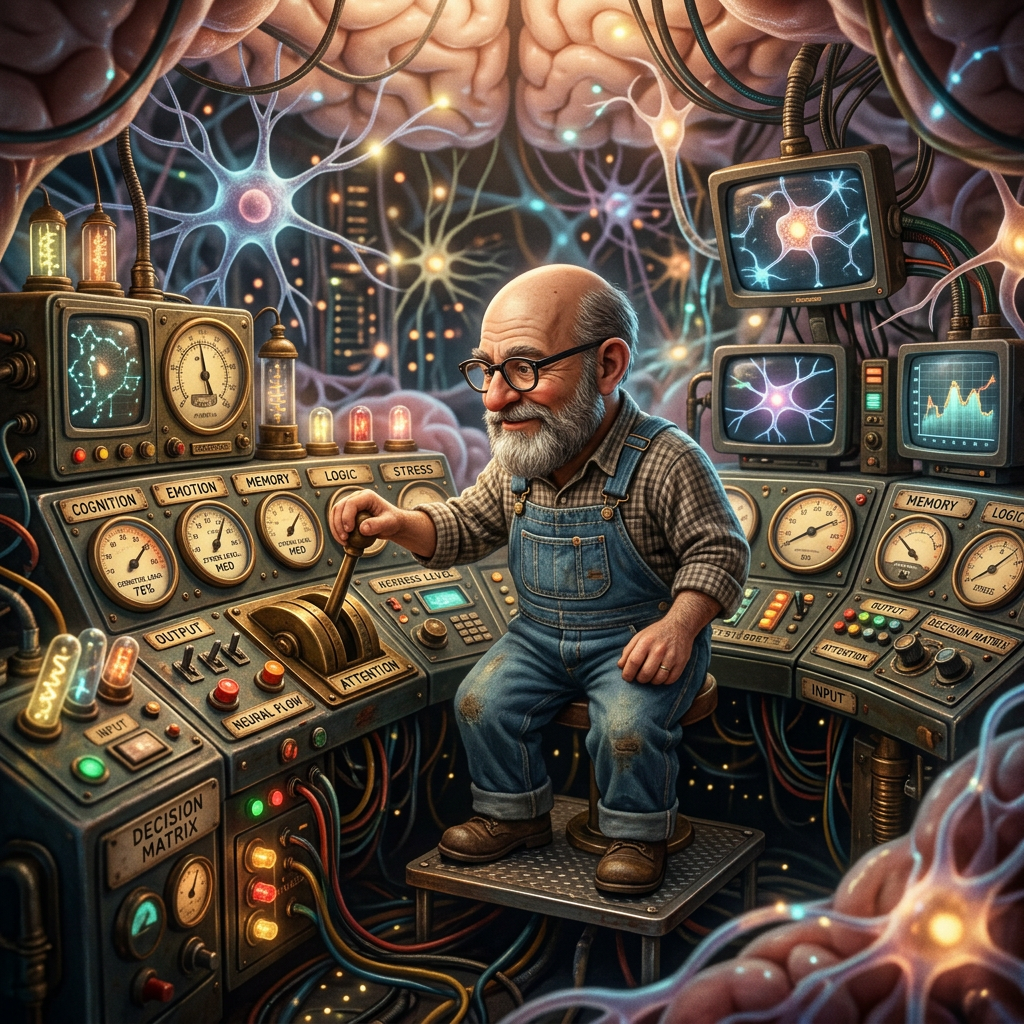
It begins with the old philosophical idea of the “Ghost in the Machine”, Gilbert Ryle’s phrase for the imagined little self living inside the mind, pulling the levers and making decisions. The tiny homunculus sitting in the control room.
Once you see it, however, you start seeing ghosts everywhere.
We imagine a self inside the mind. We imagine a God somewhere inside the universe. We imagine a ruling elite somewhere inside the economy. We imagine a planner somewhere inside society. We imagine that behind every coherent system there must be a little person dressed in overalls, surrounded by dials and switches, making everything happen.
The idea is deeply intuitive.
After all, our own lives seem to have a centre. We experience ourselves as an “I”. It feels natural to assume that behind every process there is a hidden actor.
But over the years I have become increasingly suspicious of this intuition.
When I look for the self, I find thoughts, memories, sensations, emotions and acts of attention. I find an ongoing process, a coherence, a continuity. What I do not find is a little person sitting behind my eyes.
Likewise, modern economies do not appear to be directed from a single control room. There are certainly powerful institutions and powerful individuals. Yet the economy itself resembles a vast recursive process of producers, consumers, workers, investors and price signals interacting with one another. There is no omniscient operator with access to all the information.
Some forms of theology make a similar mistake. God is imagined as a superhuman being somewhere “out there”, pulling cosmic levers. Yet many mystical traditions insist that this image is far too simple. Ultimate reality may not be another agent within the system.
Perhaps the same cognitive habit is at work in all these cases.
We see order and infer a hidden operator.
We see a process and imagine a manager.
We see coherence and invent a controller.
Perhaps this is because our minds are uncomfortable with emergence. We struggle to believe that something can be real without there being a little thing somewhere that is in charge of it.
The irony is that my own life has followed the same pattern.
For years I imagined a little manager inside me armed with an operations manual.
The manual said:
- Get educated.
- Develop your abilities.
- Obtain professional status.
- Achieve success.
- Prosper.
The manager believed he was pulling the correct levers.
Eventually some of the levers stopped working. Others came off in his hand. The operations manual turned out not to be a description of reality at all but a collection of inherited narratives.
And then came the unsettling discovery.
There was no manager.
There was no control room.
There was only a human being carrying stories, hopes, fears, ambitions and vulnerabilities whilst navigating a world that proved more complex than the manual had suggested.
Perhaps that is the real Ghost in the Machine.
Not a soul hidden inside the mind.
Not a deity hidden inside the universe.
Not a capitalist hidden inside the economy.
But our persistent belief that every coherent process must have a hidden controller.
I am beginning to suspect that much of wisdom consists of slowly learning otherwise.


Leave a Reply