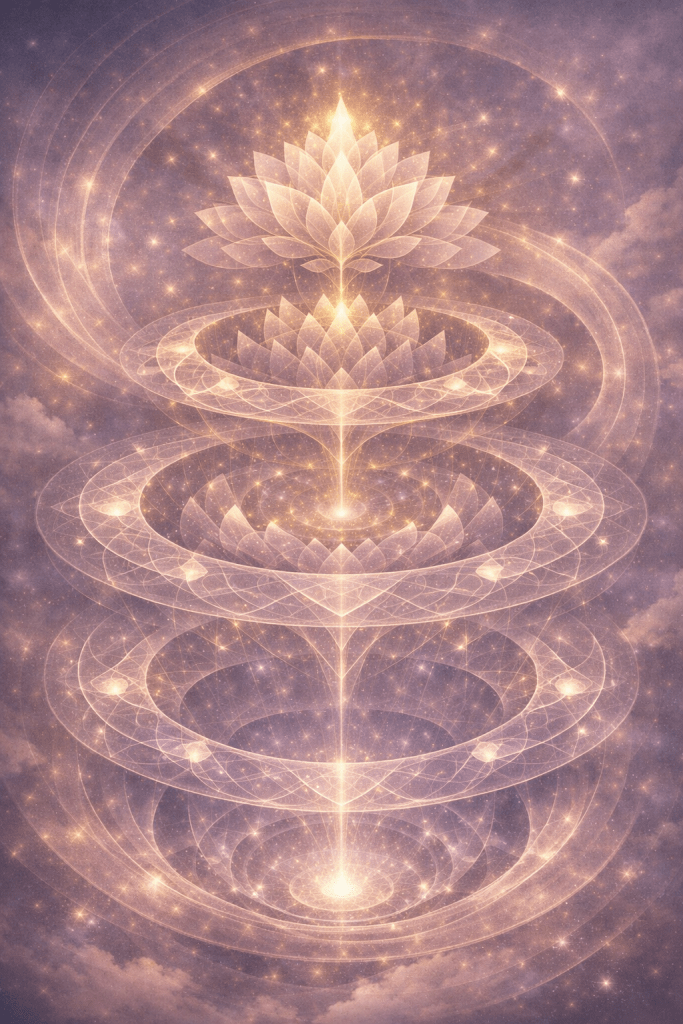
This essay is a companion piece to my earlier Logos Weave writings and the post on the Three‑Level Universe. Together they form a developing metaphysical tapestry — an attempt to think through the nature of consciousness, divinity, and meaning without dogma, holding both belief and doubt lightly. Where the Three‑Level Universe outlined the architecture of reality, this piece explores how that structure reframes three perennial questions: God, immortality, and evil.
1. God as Process, Not Person
In this framework, “God” is not a supreme being standing outside the world but the infinite Ground expressing itself through the world’s unfolding. At Level 1, this Ground is pure generativity — the capacity‑to‑be. At Level 2, it becomes relational order — the archetypal field of pattern and meaning. At Level 3, it manifests as embodied process — the living cosmos.
So “God” is not omnipotent in the coercive sense. The divine is at work within limitation, not above it. It is omnipotent only in the eventual, integrative sense: the power that persists through all change, drawing every fragment back toward coherence.
This reframes divinity as becoming rather than being — an infinite consciousness evolving through finite minds, learning itself through the world’s multiplicity.
2. Immortality as Resonance, Not Duration
If Level 3 is the temporal world — birth, growth, decay, death — then immortality cannot mean endless time. It must mean continuity of resonance between levels.
Each life traces a coordinate: a – b – c, where
- a is birth,
- b is death,
- c is the depth of consciousness attained — the degree to which one’s finite pattern resonates with the infinite field.
In symbolic terms, the life becomes a – b raised to the power of c. That exponent is the measure of participation in Level 2 — the archetypal field that preserves pattern beyond physical dissolution.
Immortality, then, is not survival of the ego but persistence of pattern: the way a melody continues to vibrate in the larger harmony after its instrument falls silent.
3. The Problem of Evil Re‑imagined
In a finite cosmos, evil is not an alien intrusion but an inevitable product of multiplicity. Every differentiation creates tension; every boundary generates exclusion. Pain, loss, and corruption are the shadows cast by finitude itself.
The divine is not absent from this process — it is at work within it, transforming discord into deeper coherence. Evil is not a moral scandal but a metaphysical necessity: the friction through which consciousness evolves.
Death enables renewal; suffering deepens awareness; limitation gives shape to love. The Ground does not prevent evil — it transmutes it, folding it back into the larger pattern.
4. Holding Belief and Doubt Lightly
This vision doesn’t demand certainty. It invites a kind of metaphysical humility: to see both faith and scepticism as modes of participation in the same unfolding.
If the cosmos is the divine learning itself through experience, then our questioning — even our doubt — is part of that learning. To ask whether God exists is already to enact the divine impulse toward self‑knowledge.
5. In Summary
- God is the infinite Ground evolving through finite consciousness.
- Immortality is resonance across levels, not endless time.
- Evil is the necessary tension of finitude, the crucible of transformation.
- Faith and doubt are twin movements of the same cosmic inquiry.
In this way, the metaphysical drama of creation, suffering, and transcendence becomes not a puzzle to solve but a story to inhabit — the story of the infinite learning to be finite, and the finite learning to be infinite.


Leave a Reply