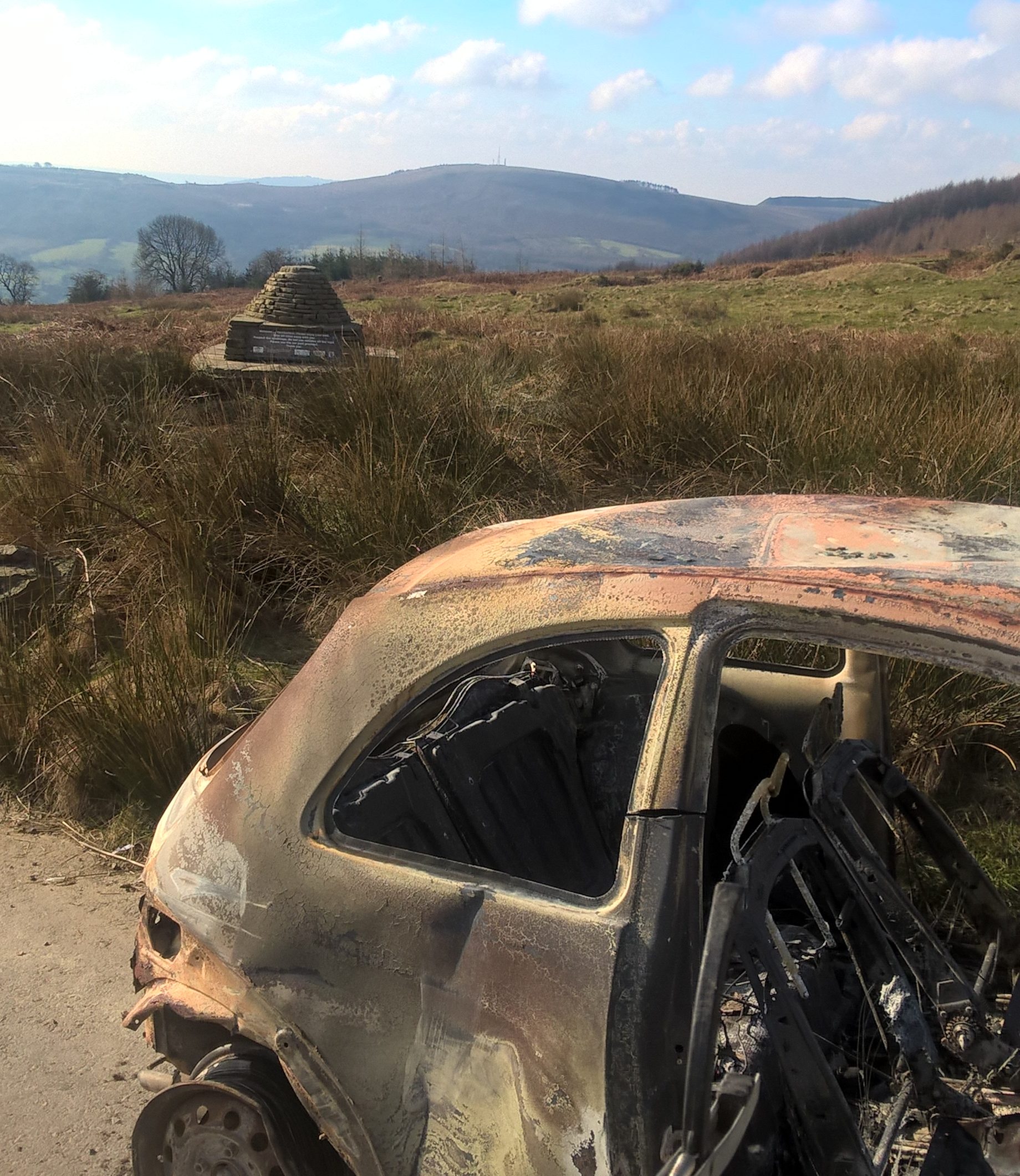
Burnt car, Twmbarlwm
Have you ever met the kind of bloke who insists on telling you some rambling story — usually the pub bore who sits alone all night at the bar? He’s always trying to collar whoever’s ordering a drink, talking to anyone who’ll listen, and a few who won’t. You know the type. Got a head full of stuff and nowhere to put it.
Well, you’re in for a treat tonight.
See, I’ve got this place in my head called Siluria. But Siluria isn’t on any map. It’s not a county, not a region, not a brand. The name comes from some old Celtic tribe, but what I mean is more like a way of looking at South East Wales — the valleys, the ridges, the estuary, the towns that’ve been up, down, and sideways over the years. It’s just my way of making sense of the place. A way of gathering all the odd bits — the nature, the industry, the history, the humour, the scars — and realising they actually sit together quite comfortably. They form a shape. A mood. A story. Even if it’s a scruffy one. Especially if it’s a scruffy one.
Because the thing about Siluria is that the land has always had the final say, no matter what we’ve tried to build on top of it. And we’ve tried plenty. Under your boots you’ve got Silurian bedrock older than anything with a pulse, heath on the hilltops with sheep deposits, Roman roads, medieval field lines, ruined farmsteads, mine workings, abandoned railways, cracked paving stones, potholes, doggy‑do, fag ends — the whole lot. It’s a mess, but it’s an honest mess. And the land remembers every chapter. The valleys run the way they run. The ridges rise where they rise. The rivers go where they want. We’ve spent centuries trying to tame the place, and the place has spent centuries shrugging and carrying on like, “Yeah, alright mate, good luck with that.”
Then there’s the new Siluria — everything turned inside‑out. People talk about the “post‑industrial valleys,” but you’d struggle to find any trace of the old industry unless you’re really looking for it or it’s been turned into a museum with a café and a gift shop. Where once there was a colliery or a steelworks, there’s now a housing estate, an enterprise park, or just a patch of wasteland that nature is quietly reclaiming, like it’s saying, “Move over, I’ll tidy this up.” The town centres, which were never in sensible places to begin with, grew prosperous with the old industry and are now hollowed out, bypassed, waiting for regeneration that never quite arrives. The shops have moved to the edge of town or off a motorway junction, and I can’t see them ever coming back. Meanwhile, massive humming pylons, wind turbines, and distribution hubs have become the new skyline — depending on your mood, either a blot or a promise. Or both, if you’re honest.
Culturally, Siluria has always been a bit awkward — in the best possible way. Historically this was the Marches, the borderlands, the frontier no‑man’s‑land where castles were built because nobody trusted anybody. Not fully Welsh, not fully English, and not especially bothered about pleasing either side. It’s always been a bit edgy in the edge lands. A hotbed of dissenting chapels, radical politics, unions, co‑ops, choirs, brass bands — places where mutual aid wasn’t a movement, it was just Tuesday. You didn’t need a theory. You just mucked in.
And the thing is, Siluria has seen the best and worst of us, often in the same street. Exploitation, poverty, pollution, dangerous work, industrial greed — yes. But also Chartism, the chapel tradition, brass bands, trade unionism, co‑operative societies, mutual aid, and the founding ethos of the NHS. The same valleys that saw workers crushed also saw workers rise. The same towns that suffered the worst of industrial capitalism also produced some of the strongest traditions of solidarity anywhere in Britain. Siluria refuses to be one thing. It’s the whole story — the good, the bad, and the stubbornly hopeful, all jammed together like a row of terraces on a hillside.
And if I’m honest, Siluria is just my way of making sense of the world through place. The industry shaped the people, who shaped the culture, which shaped the politics, which shapes the future — but the land shaped everything. In posh talk, someone would call it psycho‑geography, but really it’s just trying to understand why a place feels the way it does, why it sticks to you, why you can be gone half your life and still know exactly where you are the second you step off the train — that cynefin sense, like the place knows you back.
Anyway — listen to me going on. You only came up for a quiet pint. Go on, mate. You get off. I’ll shut up now.
 Hearth and Heart Magazine
Leave a comment