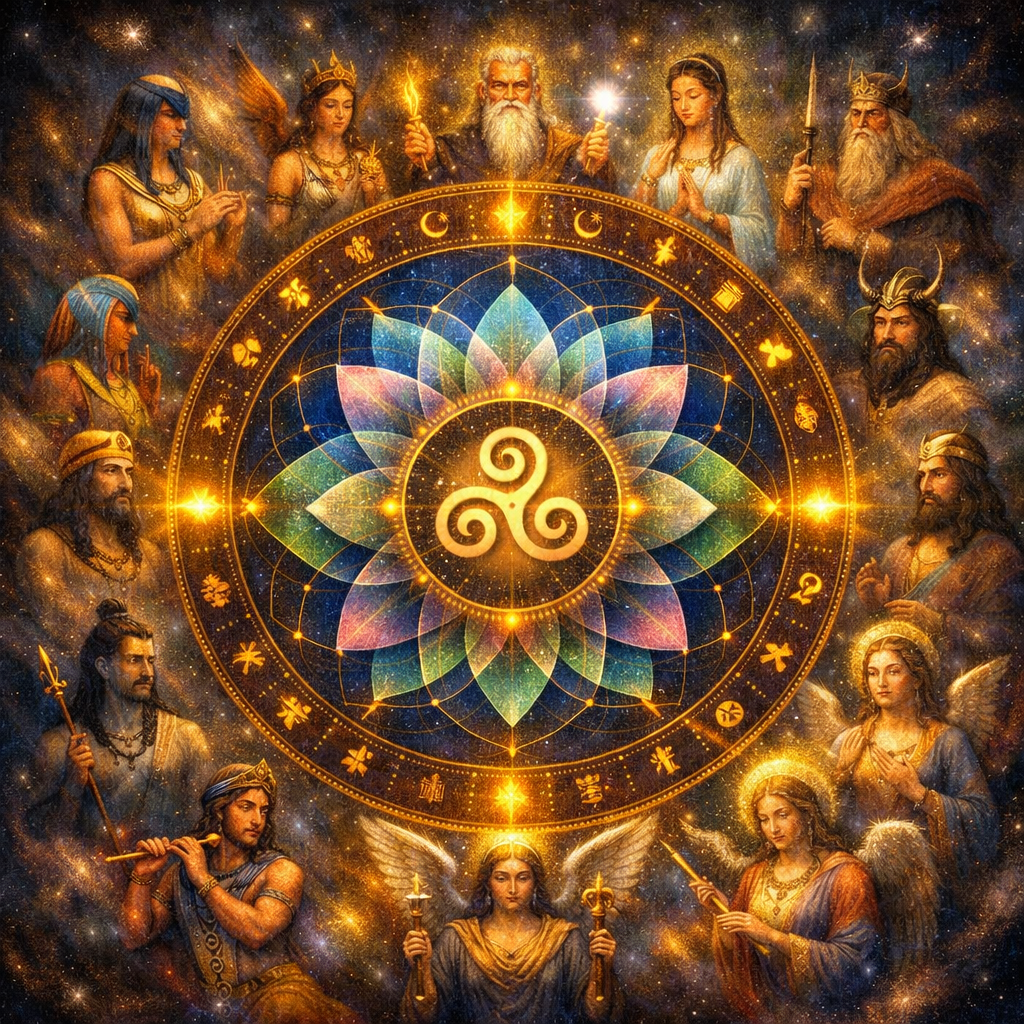
One of the most persistent questions in modern thought is this: What are human beings actually doing when they engage in religion? Not just socially, not just psychologically, but metaphysically.
Materialist accounts tend to say “nothing real is happening.” Radical atheistic accounts say religion is illusion, projection, or social control. But these explanations feel thin. They explain away the phenomenon rather than explaining it.
My own metaphysics offers a different approach — one that preserves meaning, depth, and interiority without requiring supernatural beings or literalist theologies. It begins with a simple but radical claim:
Reality is mind‑suffused at every level
Consciousness is not a late evolutionary accident. It is not a by‑product of matter. It is not a glitch in an otherwise dead universe.
Instead:
- Mind and matter are two faces of the same underlying reality.
- Interiority is woven into the fabric of existence.
- Every level of being has an inner aspect.
This means the universe is not a machine. It is a field of interiority — alive, aware, and capable of meaning.
The cosmos has a unified interiority — a cosmic consciousness
If mind goes “all the way down,” it also goes “all the way up.”
At the highest level of integration, the cosmos has a unified interior depth — not a person, not a deity with moods or preferences, but a vast, coherent cosmic consciousness.
This is the “Deep” that mystics across cultures have intuited:
- Plotinus’ Nous
- The Vedantic Brahman
- The Kabbalistic Ein Sof
- The Tao of the Taoists
Not anthropomorphic. Not egoic. Not a sky‑father.
But the interiority of the whole — the mind‑like depth of reality itself.
Human beings encounter this depth through archetypal attractors
Here is the crucial move.
The psyche is relational. It cannot relate to pure abstraction. So when it encounters the Deep, it gives that encounter a face.
This is where archetypes come in.
Archetypes are:
- stable patterns in the imaginal‑material field
- recurring forms of meaning
- relational “interfaces”
- the shapes through which the Deep becomes encounterable
They are not fictions. They are not hallucinations. They are the forms the Deep takes when it meets the human mind.
This is why gods appear as:
- shepherds
- fathers
- mothers
- kings
- lovers
- ancestors
- heroes
These are the faces the Deep wears in human consciousness.
Culture clothes these archetypes in stories, myths, and ancestral memory
Different cultures inherit different symbolic languages. They stabilise different archetypes. They preserve different ancestral memories.
So:
- Yahweh
- Christ
- the Buddha
- the Orishas
- the Greek gods
- the Celtic gods
- the saints
- the ancestors
…are not competing metaphysical claims.
They are different cultural expressions of the same underlying archetypal attractors.
Religion is plural because culture is plural. But the depth behind them is one.
Religious practice aligns the psyche with the Deep
This is the heart of the theory.
When people:
- pray
- worship
- meditate
- chant
- perform ritual
- gather in community
- tell sacred stories
…they are not performing empty gestures.
They are:
aligning their psyche with the deep interiority of reality through symbolic, relational, and communal forms.
Prayer is the psyche turning toward the Deep. Worship is the ego relaxing into something larger. Ritual is the technology of alignment. Myth is the narrative face of archetypal truth. Community is the shared field in which alignment becomes stable.
Religion is not superstition. It is metaphysical practice.
A living, meaningful universe
This framework allows us to understand religion without:
- literal supernatural beings
- reductionism
- cynicism
- anthropomorphism
It gives us a universe that is:
- alive
- interior
- meaningful
- relational
- symbolically rich
- spiritually resonant
And it gives us a way to understand religious life as:
Human consciousness responding to the Deep — through archetype, story, symbol, and community.
Not illusion. Not projection. Not error.
But participation.
 Hearth and Heart Magazine
Leave a comment