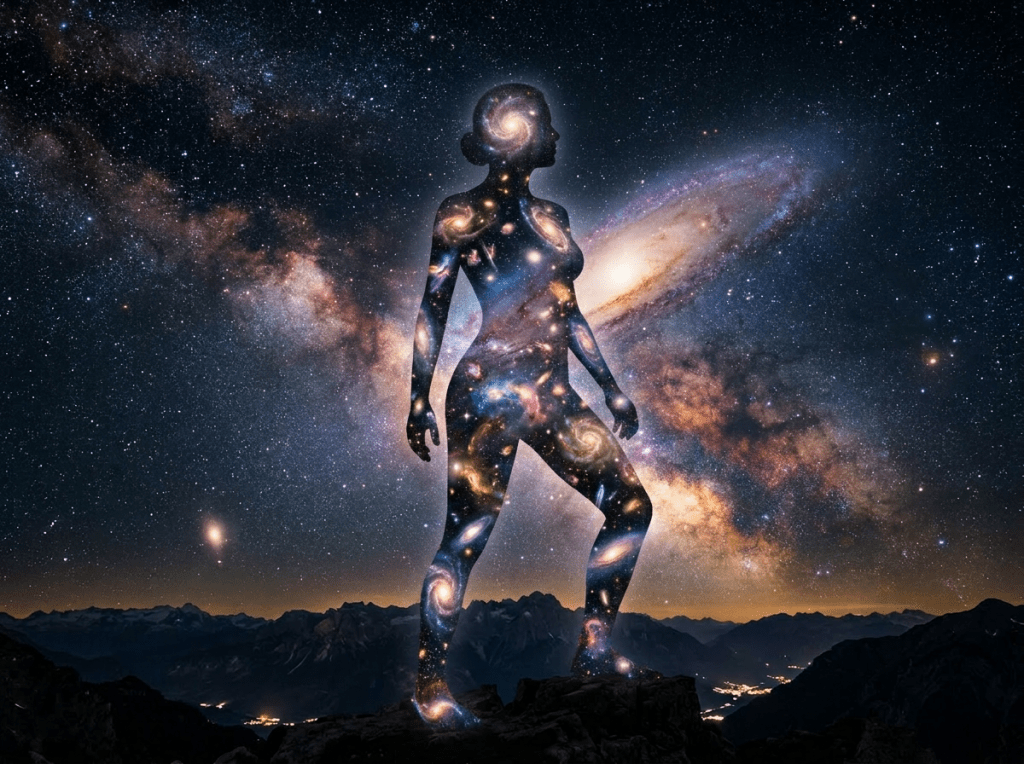
For many people, metaphysics feels too abstract to touch the deeper human longing for a God who loves — not as an impersonal force or a pattern of coherence, but as a presence that desires intimacy, cares for the individual, and grieves their wounds. Modern thought often dismisses this longing as a wish for a cosmic parent figure, a projection of need onto an indifferent universe. Yet the longing persists, even among those who no longer believe in a supernatural deity. The real question becomes: how close can a non‑supernatural metaphysics come to what devotees describe as a personal relationship with deity? How far can it approach the sense of being known, wanted, and held?
Within a three‑resolution metaphysics, two coherent pathways emerge.
1. The Cosmos as a Personal Deity
The first imagines a personal deity co‑extensive with space and time — the interior life of the universe itself. Here, the cosmos is the “body” of God, and the personal deity is its inner consciousness. Such a deity would not be omnipotent in the classical sense, nor omniscient in the timeless sense, but it could still possess something recognisably like desire, care, and grief. A conscious cosmos could long for the flourishing of its parts, feel the diminishment of their suffering, and experience the absence of a beloved centre of experience as a wound in its own interiority. In this model, “God loves me” means that the universe‑as‑person bends toward the good of its members, holding each life within a field of genuine concern.
2. The Personal Deity as the Noospheric Mode of Level 3
The second pathway treats the personal deity as the noospheric or psychological mode of Level 3 reality — the emergent interiority of all minds taken together. Here, “God” is not a cosmic person but the relational field in which individuals encounter the Archetypal layer. The divine appears as the Higher Self in its personal mode, carrying the full phenomenology of intimacy, guidance, grief, and care. The noosphere evolves through the lives of sentient beings; it is enriched by their presence and diminished by their absence. When the personal deity is understood as the way this field meets the individual, divine love becomes the experience of being wanted, valued, and accompanied by the very structure of meaning itself.
Toward a God Who Loves in a Human Key
Neither model restores the supernatural parent‑figure of classical theism. But both create a conceptual space in which the world can meet the individual with something more than cold intelligibility. In the cosmic‑person model, love is the interior orientation of the universe toward its own flourishing. In the noospheric model, love is the way the Archetypal field becomes intimate and responsive within consciousness. In both cases, the divine can desire presence, grieve absence, and rejoice in the unfolding of the beloved — not because it is a human‑shaped being, but because reality is capable of appearing in a personal key.
The question “Does God love me?” is not answered by metaphysics alone. It is answered in the lived encounter — in the way the world discloses itself as meaningful, supportive, and quietly oriented toward the good of the beings within it.
 Hearth and Heart Magazine
Leave a comment