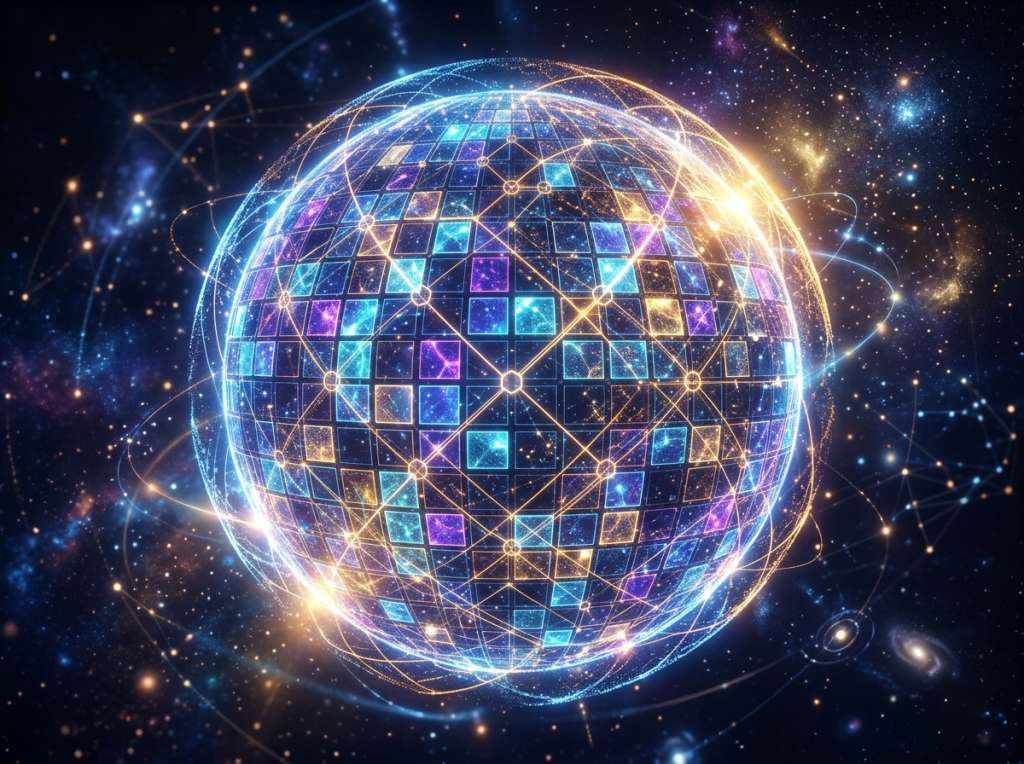
In an age when political imagination feels exhausted, the Politics of Scale demands that we think again about how human beings organise themselves. The old binaries — centralisation versus localism, globalism versus nationalism, technocracy versus democracy — no longer map cleanly onto the world we actually inhabit. What we need is a political architecture capable of holding together the intimacy of place with the reality of planetary interdependence. The Cybernetic Mosaic is my attempt to sketch such a framework: a post‑liberal, communitarian, subsidiarity‑driven model of governance that preserves local culture while acknowledging the scale of the challenges we face.
At its heart, the Cybernetic Mosaic begins with a simple conviction: human flourishing is rooted in the local. Communities, languages, landscapes, and inherited ways of life are not obstacles to progress but the very conditions that make meaning possible. A politics that erases these in the name of efficiency or uniformity is a politics that hollows out the human spirit. Subsidiarity — the principle that decisions should be made at the lowest competent level — is not merely an administrative preference but a moral one. It protects the dignity of communities and the diversity of cultures that make up our shared world.
Yet subsidiarity alone cannot solve the problems that transcend borders: climate instability, mass migration, ecological collapse, and the governance of technologies that operate at planetary scale. Here the Cybernetic Mosaic introduces a second layer: parallel AI advisory systems — not rulers, not sovereigns, but oracles. Their role is to provide transparent, adversarial, evidence‑based modelling of long‑term risks and trade‑offs. Crucially, these systems do not govern. They do not command. They do not replace human judgement. Instead, they serve as neutral instruments of clarity, helping human institutions see further and more honestly than partisan politics usually allows. Humans remain firmly in charge; the machines illuminate, but they do not decide.
The result is a world that is legally one but culturally many. Local communities retain control over their heritage, their social pace, their land, and their identity. Regional and national layers coordinate shared resources. And above them sits a thin, global tier — not a world‑state, not a Leviathan, but a custodian of planetary systems, informed by transparent AI modelling and accountable to humanity. The Cybernetic Mosaic is not a utopia; it is a thought‑experiment in political realism, an attempt to imagine how we might preserve the richness of human difference while acting together on the challenges that no community can face alone.
If the 20th century was the age of the nation‑state and the 21st the age of the network, perhaps the 22nd will belong to the Mosaic — a civilisation that finally learns to balance scale with soul.
 Hearth and Heart Magazine
Leave a comment