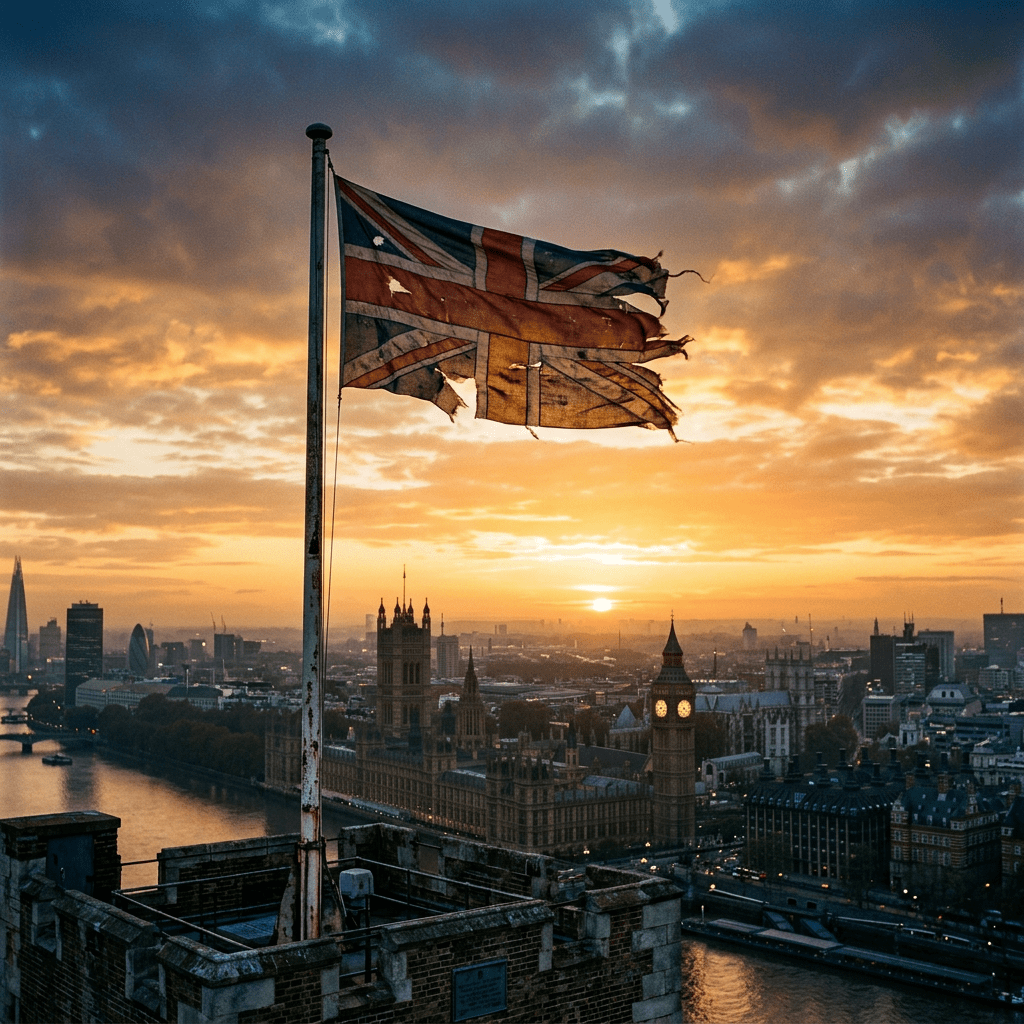
There is a quiet grief that many Britons carry, though few feel comfortable speaking it aloud in polite company. It is the realization that the country we inherited—or the one our parents and grandparents built—has fundamentally ceased to exist.
Between 1948 and the mid-2020s, a quiet revolution took place. Through a mix of post-war corporate appetite for cheap labor, managerial negligence, and an ideological commitment to globalism, the historical, high-trust, culturally homogenous nation of Old Britain was dismantled. In its place sits the “Yoo-Kay”: a fragmented, atomized administrative zone where communal bonds have been replaced by legal statutes, and high social trust has been traded for hyper-diversity and institutional cynicism.
To look back on this seventy-year shift is to witness a tragedy of historical proportions. Shared history, deep ancestral roots, and an unwritten social contract built over centuries were unraveled in a mere couple of generations—all without the explicit consent of the people who lived here.
Yet, as understandable as nostalgia is, it is not a political strategy.
History is a one-way street. The demographic “Humpty Dumpty” cannot be put back together again. Short of barbaric, totalitarian measures—which anyone claiming to love British civilization must utterly reject—there is no rewinding the clock. The fantasy of returning to 1950 through ethnic nationalism is not just politically impossible; it is a revolutionary trap that would destroy the rule of law and civil liberties, killing the very patient it seeks to cure.
So where does that leave those who value order, high trust, and national identity?
They are left with tragic pragmatism.
We must accept the modern baseline as it is, not as we wish it were. If we are to avoid total balkanization and civil friction, the path forward cannot be ethno-nationalism, but an uncompromising High Civic Nationalism built on robust integration.
The goal should never be rigid, French-style assimilation—the Total State demanding the erasure of all personal identity and heritage, which is fundamentally un-British. Rather, as thinkers like Eric Kaufmann, Matt Goodwin, and Peter Hitchens have pointed toward in different ways, peace in a post-homogenous state relies on three non-negotiable pillars:
- Stop the Rate of Acceleration: We must drastically reduce incoming migration to an economically and culturally sustainable level. A society cannot integrate new members when the ground beneath its feet is constantly shifting.
- Ditch State-Sponsored Balkanization: The state must stop funding parallel societies and celebrating fragmentation at the expense of unity.
- Demand Robust Civic Integration: We must forge a rigorous shared baseline. Private differences remain private, but in public life, every citizen—regardless of heritage or ancestry —must unreservedly align under the authority of the same law, fluency in English (or one of the insular Celtic tongues) civic duty, and respect for the nation’s historic institutions.
Old Britain may be a gone, but the future of this island is still worth fighting for. We cannot resurrect what was lost, but through strict civic cohesion and realistic policy, we can still build a peaceful, high-trust home out of the country we have today.
 Hearth and Heart Magazine
Leave a comment