This is a work in progress and intended for discussion rather than as a finished constitutional proposal.
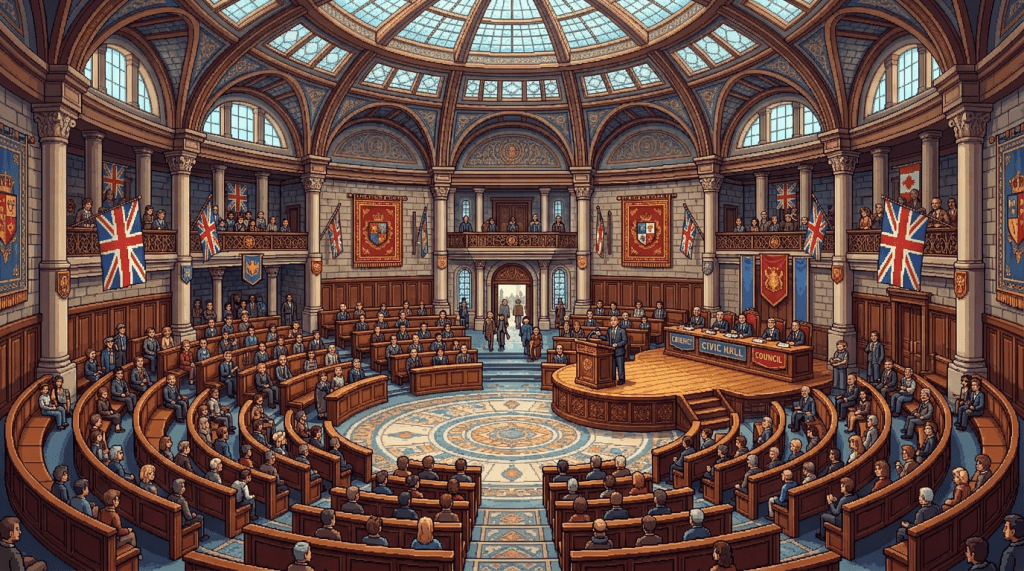
Modern democracies often speak of “popular sovereignty”, yet in practice sovereignty is usually exercised through institutions such as parliaments, governments, courts and bureaucracies. Over time, these institutions can come to be viewed not merely as instruments of the people, but as holders of sovereign power in their own right.
I have been exploring an alternative concept which might be described as a Stakeholder Republic. Its starting point is simple: sovereignty belongs to individual citizens and is never permanently transferred to any institution. Citizens may delegate powers for practical purposes, but they do not surrender them.
In this view, government is not sovereign. It is a temporary mandatary acting on behalf of sovereign citizens, who remain the mandators.
Under such a system, elections would still occur every four or five years. Political parties or governing teams would present programmes and objectives to the electorate, much as they do now. However, the constitutional understanding would be different. An election would not confer sovereignty upon the winning party. Rather, it would grant a mandate to administer public affairs within defined constitutional limits.
The elected government would enjoy significant discretion in carrying out that mandate. It would not be expected to seek permission for every administrative decision. Effective government requires room to govern. Yet that authority would always remain delegated rather than inherent.
Importantly, the mandate would contain a sunset clause. At the conclusion of the elected term, the delegated authority would expire unless renewed by the electorate. Governments would therefore be custodians of delegated power, not owners of it.
The principle of subsidiarity would play a central role. Decisions should be taken at the lowest practical level. Powers should only be exercised by higher levels of government when they cannot reasonably be exercised by individuals, households, communities or local authorities.
This implies a constitutional presumption that powers remain with citizens unless explicitly delegated upwards. Matters not delegated would be considered beyond the competence of central government.
Government would recover the costs of its activities through taxation, which might be understood as civic fees for services and functions delegated to the public sphere. Different taxation models could be adopted, including flat-rate or progressive systems, but the philosophical justification would not be state sovereignty. It would arise from the costs of carrying out delegated responsibilities on behalf of citizens.
Alongside rights, such a republic would recognise certain fundamental duties.
The first would be a duty of non-harm. Citizens would enjoy extensive personal freedom, but that freedom could not be exercised in ways that unjustly impair the equal freedom of others.
The second would be a fiduciary duty extending across generations. This principle may be the most distinctive aspect of the proposal.
Natural resources such as land, water, air, ecosystems and mineral wealth should not be regarded simply as assets belonging to the present generation. Rather, they form part of a permanent civic inheritance held in trust across time.
The beneficiaries of that trust include citizens living today, those who contributed in the past and future generations yet to be born.
Under this principle, the Republic would act as trustee of natural capital. Resources could be utilised and their economic value realised, but permanent degradation or irreversible loss would be prohibited. Profits derived from such resources might flow into a sovereign wealth fund so that society as a whole shares in their benefits while preserving the underlying capital.
In institutional terms, this model would separate administration, law and expertise more clearly than many current democratic systems.
The elected government would manage public affairs within the scope of its mandate.
A judicial-arbitral system would oversee the development and application of law through legal expertise, dispute resolution and independent inquiries where necessary.
A legislative body of communal delegates could contribute local and civic perspectives to the formation of legal frameworks without necessarily claiming sovereign authority.
Alongside these institutions there could be a college of experts tasked with providing independent assessments on scientific, environmental, technical and economic matters. Such a body would possess influence through knowledge rather than power through command.
None of these institutions would be sovereign. Each would exercise limited delegated functions within a constitutional framework grounded in citizen sovereignty.
The proposal is not intended as an attack on representative democracy. In many respects it remains democratic. Governments would be elected, mandates would be issued through popular consent, and public accountability would remain central.
The difference lies in how authority is understood.
Instead of asking, “Who should exercise sovereignty?”, the Stakeholder Republic asks whether sovereignty should reside anywhere other than with the citizen at all.
Likewise, it asks whether constitutional systems should recognise obligations not only to current voters but also to future citizens whose interests are currently unrepresented.
These ideas are far from complete and raise many practical questions about implementation, accountability, constitutional design and dispute resolution. Nevertheless, they may provide a useful basis for discussion about how democratic societies can combine liberty, responsibility, effective government and long-term stewardship.
At its heart, the proposal is guided by a simple principle: power should be exercised as a trust, not possessed as a right.
For discussion: If government is best understood as a temporary mandatary of citizens rather than a sovereign authority in its own right, what constitutional safeguards would be needed to make such a system both effective and stable?
 Hearth and Heart Magazine
Leave a comment