On Resilience, Anxiety, and Not Running Aground
At the time of writing, my ordinary working life is passing through a period of instability. The details are less important than the general experience. A career setback, a period between jobs, uncertainty about the future, or the collapse of a carefully constructed plan all produce a similar psychological effect.
The sea becomes rough.
Human beings like maps. We like routines, expectations and stories about where our lives are going. Even when we complain about them, these things provide structure. They help us answer the question:
“What happens next?”
An unstable period removes that certainty. The future becomes foggy. The mind, being an industrious creature, immediately gets to work inventing possible disasters.
This is what anxiety often feels like.
Not fear of a specific danger, but an inability to see the coastline.
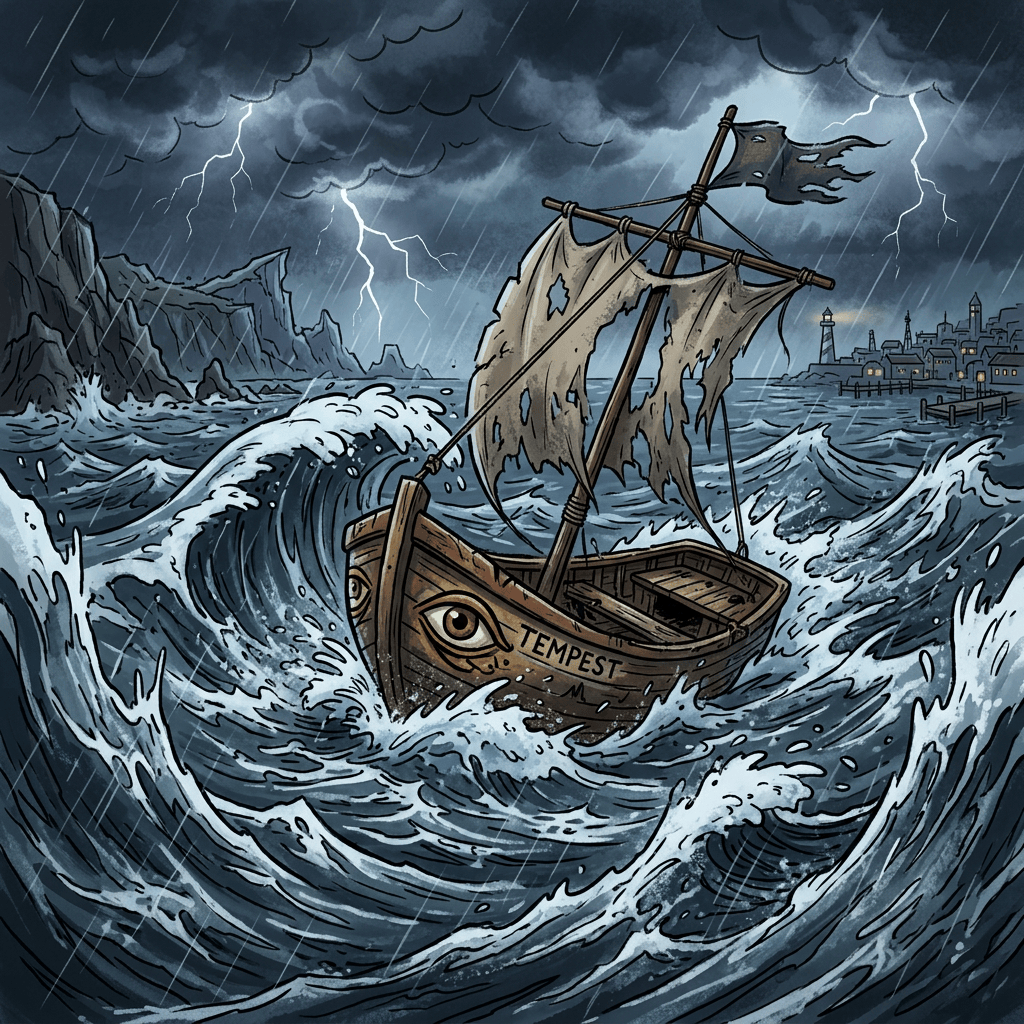
One moment you are steering confidently towards a visible harbour. The next you are a small cartoon boat bobbing about on oversized waves with worried little eyes painted on the bow.
The metaphor is quite deliberately cute.
Perhaps unbearably so.
But it is also useful.
The Myth of Toughness
When people speak about resilience they often describe a kind of psychological armour.
Nothing affects the resilient person. Nothing hurts them. Nothing worries them.
This has not matched my experience.
True resilience is not being unaffected by a storm.
A boat that never moves in rough water is not resilient; it is made of concrete and has already sunk.
The resilient vessel moves with the sea.
It creaks.
It lists.
It occasionally spills tea.
But it remains afloat.
Resilience is therefore not the absence of anxiety.
It is the ability to remain coherent while anxiety is present.
Coherence and Adaptation
The best definition of resilience I have encountered in my own reflections is this:
Resilience is maintaining coherence during instability while remaining capable of adaptation.
The two parts are equally important.
Without coherence, we become fragmented. Every new development sends us rushing in a new direction.
Without adaptation, we become rigid. We retreat into old certainties and refuse to engage with reality as it actually is.
Many people respond to instability by hunkering down permanently.
The psychological equivalent of dropping anchor in the middle of a shipping lane.
Nothing can hurt them there.
Unfortunately nothing much can happen either.
Life requires some openness to the world.
Adaptation means remaining willing to:
- learn;
- change;
- take opportunities;
- meet new people;
- revise plans;
- move with events.
The trick is to do this without losing oneself.
Ports in a Storm
A little boat cannot control the weather.
It can, however, know where the nearest harbour is.
Periods of instability reveal the importance of what I think of as ports in a storm.
These are the stable things that remain when other things are changing.
For some people these may be:
- Family.
- Friends.
- Partners.
- Children.
- Pets.
- Hobbies.
- Clubs.
- Favourite places.
- Belief systems.
- Faith communities.
- Long-standing routines.
Not every anchor has to be grand or profound.
A dog demanding a walk every morning is surprisingly resistant to economic shocks.
A hobby pursued weekly may survive employment changes, house moves and personal upheavals.
A friendship continuing through success and failure provides a reminder that one’s identity is larger than one’s current circumstances.
The point is not that these things remove the storm.
The point is that they remind us we still exist outside it.
Boundaries and Navigation
Anchors alone are not enough.
A sailor also needs navigation.
In psychological terms this means boundaries.
I do not mean barriers against the world.
I mean sensible limits.
For me these include:
- Personal privacy.
- Personal space.
- Personal time.
- The ability to decline unreasonable demands.
- Not attempting to be all things to all people.
- Accepting disagreement.
- Accepting silence.
- Accepting uncertainty.
Many anxieties are really disguised attempts to force certainty before certainty is available.
A healthy boundary often sounds like:
“I do not know yet.”
Or:
“I do not need to decide this today.”
Or even:
“Nothing is happening right now, and that is acceptable.”
This ability to wait may be one of the most underrated psychological skills.
The sea does not obey our timetable.
Sometimes the wisest action is simply keeping the bow pointed in roughly the right direction and waiting for visibility to improve.
Silence
One lesson I continue to learn concerns silence.
Anxious minds dislike silence.
They immediately begin filling it.
No email means disaster.
No phone call means disaster.
No update means disaster.
No evidence becomes evidence.
Yet often silence is merely silence.
Nothing more.
Learning to tolerate the absence of immediate answers is, in some ways, learning to tolerate reality.
Many important developments happen slowly.
The tide turns gradually.
The fog lifts gradually.
Opportunities appear gradually.
A great deal of unnecessary suffering comes from demanding answers before the world is ready to provide them.
Not Running Aground
The purpose of boundaries is not confinement.
It is navigation.
Harbour walls exist because rocks exist.
Charts exist because reefs exist.
The sailor who respects limits travels further than the sailor who ignores them.
Likewise, healthy personal boundaries do not isolate us from life.
They protect our ability to participate in it.
Without privacy, space and time, we become exhausted.
Without limits, we become overwhelmed.
Without rest, we become reactive.
Soon every wave feels like a catastrophe.
The boat begins taking on water for no reason other than exhaustion.
Good boundaries prevent this.
Final Thoughts from a Slightly Seasick Boat
Living through a storm of instability is unpleasant.
I would not recommend it as a life style choice.
Yet periods of uncertainty reveal things that stable periods often conceal.
They reveal:
- what matters;
- who matters;
- which beliefs endure;
- which routines sustain us;
- which relationships are genuine.
Resilience is not invulnerability.
It is not permanent optimism.
It is not pretending the weather is good when it plainly isn’t.
It is maintaining enough coherence to remain oneself while remaining open enough to adapt.
A little boat survives not because the storm ceases.
It survives because it has anchors, harbours, charts, boundaries and just enough flexibility to move with the waves instead of fighting every one of them.
And if the little boat happens to look faintly ridiculous bobbing about on enormous waves with a cheerful flag on top, so much the better.
There are worse things than being a slightly seasick sailor.
One of them is never leaving the harbour at all.


Leave a Reply