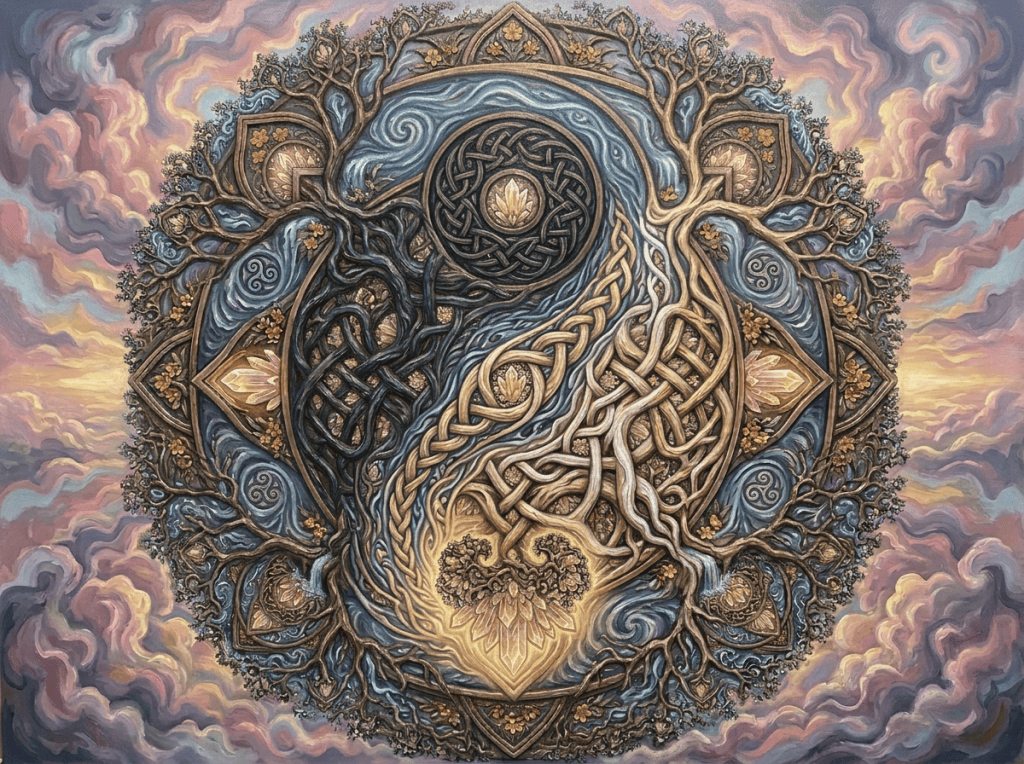
Being, Isness and Suchness: Towards a Relational Ontology
Introduction
Western philosophy has traditionally begun with the question:
Why is there something rather than nothing?
Yet this question assumes that “nothing” is a genuine possibility.
It may not be. If non-being is incoherent, then Being is unavoidable. The question becomes not why Being exists, but how Being is structured.
This essay proposes that Being may be understood as the inseparable relation between two aspects:
- Isness: that something is.
- Suchness: what something is.
These are distinguishable but inseparable moments of Being. Their dynamic relation gives rise to a continuum of relational possibility within which stable beings emerge.
The Great I AM
Perhaps the simplest expression of Being is contained in the phrase:
I AM.
This statement contains two irreducible moments.
The first is:
I
Identity.
Thisness.
Count.
Suchness.
***
The second is:
AM
Presence.
Actuality.
Existence.
Isness.
Neither is intelligible without the other.
An “I” which does not exist is nothing.
An “AM” without any determination is unintelligible.
***
Thus Being appears to contain an irreducible polarity:
Suchness ↔ Isness
Identity ↔ Presence
“I” ↔ “AM”
These are not opposites in the ordinary sense. They are complementary aspects of a single reality.
Unity and Infinity
The same polarity appears when we consider the relationship between unity and infinity.
A truly infinite reality cannot merely be endless extension.
It must also be all-encompassing.
But all-encompassing means:
contained
coherent
whole
In other words, it already possesses unity.
Likewise, a unity which contains all that is possesses no outside.
It therefore lacks any ultimate limit and tends conceptually towards infinity.
Thus:
Unity ↔ Infinity
The two become limiting descriptions of the same Absolute.
The Absolute is not one side of this relation.
It is the coincidence of both.
The Continuum of Relational Possibility
If Being is the dynamic relation between isness and suchness, then Being may be understood as a continuum of relational possibility.
Conceptually this stretches between:
0 relations
and
∞ relations
Between these poles lies the manifold of all possible arrangements.
This manifold is not composed of things.
It is composed of possible relations.
Dimensions, structures, geometries and forms may all be viewed as expressions of relational possibility.
Being is therefore not primarily a collection of objects.
It is a field of possible relations.
Possibility and Persistence
However, the existence of a possibility does not imply its persistence.
Most possible arrangements never endure.
Many are fleeting.
Many collapse immediately.
Many are internally incoherent.
The crucial distinction is therefore not between:
possible
and
impossible
but between:
possible configurations
and
stable configurations
Reality seems to contain an immense number of theoretical possibilities but only a relatively limited number of persistent forms.
A being emerges where a relational configuration possesses sufficient stability to endure through time.
Aggregates and Systems
Not every collection of things constitutes a genuine being.
A heap of stones is largely an aggregate.
A living organism is a system.
The difference lies not in the number of components but in the coherence of their relations.
A true system possesses:
- internal organisation,
- persistence,
- stability.
A being is therefore best understood as:
A relatively stable relational configuration.
The world appears less like a collection of substances and more like a landscape containing stable and unstable arrangements.
Within a vast sea of possibility, some configurations become persistent attractors.
These are the beings of our experience.
The Recursive Structure of Being
At this point the argument folds back upon itself.
Why do some configurations persist?
Because they themselves exhibit the same structure discovered in Being.
Every being possesses:
Presence
+
Coherence
or:
Isness
+
Suchness
A person possesses presence and identity.
A family possesses presence and identity.
A nation possesses presence and identity.
A civilisation possesses presence and identity.
The structure discovered in Being therefore reappears within beings.
The ontology is recursive.
The Many are not separate from the One.
They are local expressions of the same pattern present within Being itself.
Stability is Conditional
Stability is never absolute.
It is always stability under particular conditions.
A configuration may be stable in one environment and unstable in another.
A fish is stable in water but not in a desert.
A business may thrive under one economic arrangement and fail under another.
A political order may flourish under one technological regime and struggle under another.
Persistence therefore depends not merely upon internal coherence but upon the relation between a configuration and its circumstances.
Change the circumstances sufficiently and stability itself changes.
New configurations may emerge as more viable.
The Human Meaning of Ontology
At this point ontology ceases to be abstract.
It becomes a description of ordinary life.
Consider a person.
You are not the same person you were ten years ago.
Your body has changed.
Your beliefs have changed.
Your relationships have changed.
Yet you remain recognisably yourself.
Why?
Not because nothing changes.
But because a stable pattern persists through change.
The self is a stable relational configuration.
The same applies to:
- friendships,
- marriages,
- families,
- careers,
- communities.
None persist by remaining unchanged.
They persist by maintaining coherence whilst adapting to changing circumstances.
Too much change brings dissolution.
Too much rigidity brings brittleness.
Successful lives occupy the difficult middle ground.
Narrative and Becoming
This also explains why stories have arcs.
A character begins within one stable configuration.
The conditions supporting it disappear.
Instability follows.
Possibilities are explored.
A new stability eventually emerges.
This is the narrative arc.
Yet life does not end there.
The process repeats.
What we call growth, development and becoming may simply be the continual formation and dissolution of stable configurations within the larger field of possibility.
A life is not a single stable state.
It is a succession of relatively stable episodes.
Conclusion
Being is neither a static unity nor an undifferentiated infinity.
It is the dynamic relation between isness and suchness, presence and identity, the “AM” and the “I”.
From this relation emerges a continuum of relational possibility stretching between the minima and maxima of relation.
Most possible configurations do not persist.
Some acquire sufficient coherence and presence to endure.
These stable configurations are beings.
The same structure that characterises Being itself reappears recursively within beings.
A person, a marriage, a family, a nation and a civilisation all display the same pattern:
coherence amidst change,
identity amidst adaptation,
stability amidst process.
Ontology therefore turns out not to be a study of remote metaphysical abstractions.
It is an attempt to understand the deepest pattern of ordinary existence itself:
how things remain themselves whilst continually changing.


Leave a Reply