The greatest obstacle to a genuinely federal United Kingdom has never been Scotland, Wales or Northern Ireland.
It has always been England.
England contains the overwhelming majority of the UK’s population, economic activity and political weight. Any federal system built around England as a single unit would quickly become an English federation in all but name. England would simply overwhelm the smaller nations.
For that reason, a workable Federal Britain requires an English settlement.
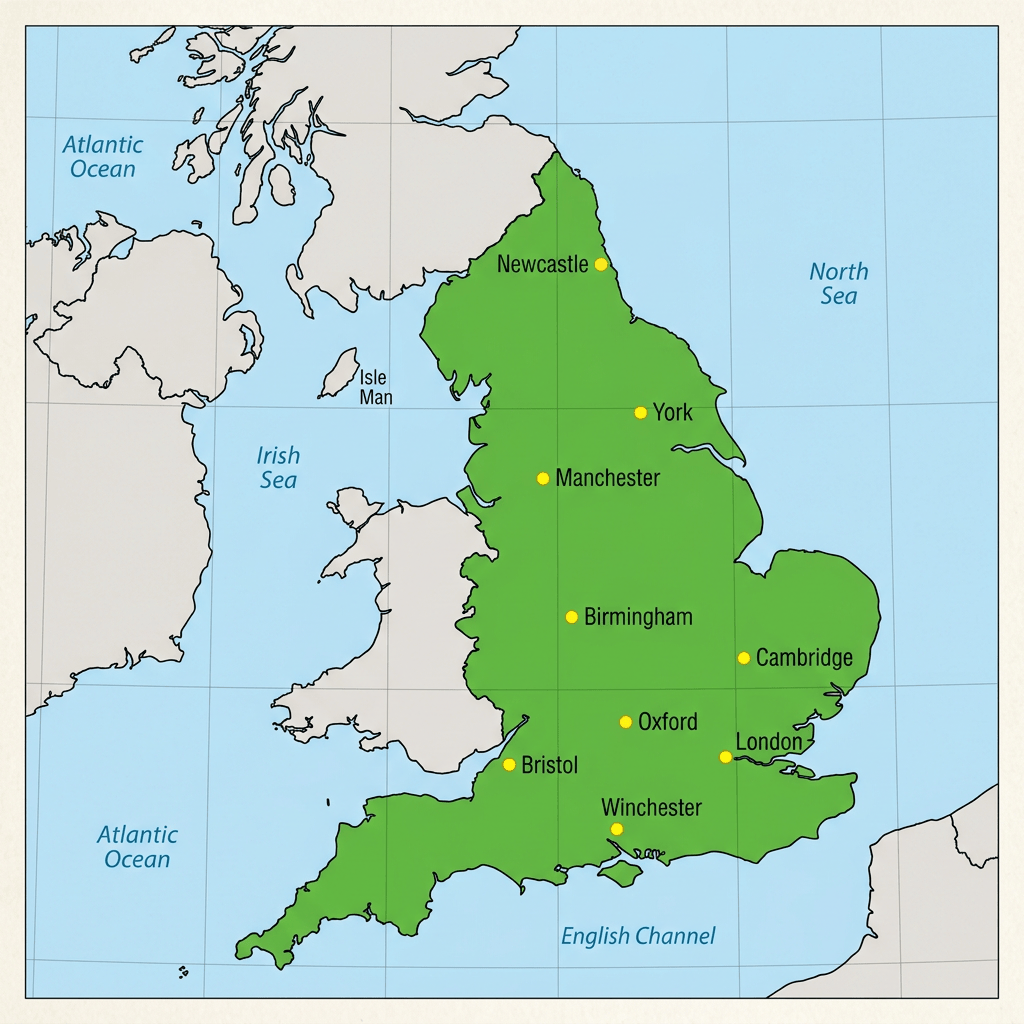
The proposal outlined here is straightforward: England remains a nation with its own Parliament, but internally federates into a number of historic and economically viable states. England would therefore become a federation within a federation.
Importantly, England would not disappear. English identity is real and deeply rooted. Instead, England would gain its own Parliament, located in York, while Britain would retain a separate Federal Parliament in London.
This arrangement would help rebalance power away from the London-centric model that has dominated British politics for centuries.
The proposed English states are:
- Northumbria
- Lancashire
- Yorkshire
- Mercia
- Wessex
- Anglia
- South East England
- London Federal District
The objective is not merely administrative convenience. Each state should possess:
- a recognisable cultural identity;
- a major city;
- significant economic infrastructure;
- meaningful transport connections;
- sufficient population to function as a serious political unit.
Northumbria
Counties
- Northumberland
- Durham
- Tyne and Wear
- Cumbria
Capital
Newcastle
Population
Approximately 4.5-5 million.
Major Infrastructure
- Port of Tyne
- Teesport
- Newcastle Airport
- East Coast Main Line
- A1 corridor
Economic Strengths
- Energy
- Ports and logistics
- Manufacturing
- Tourism
- Defence industries
- Offshore industries
Weaknesses
- Geographic remoteness
- Lower population density than the English average
Cultural and Historical Identity
Northumbria possesses one of the strongest historical identities in England. It combines:
- The old Kingdom of Northumbria
- Durham’s ecclesiastical tradition
- Hadrian’s Wall
- The Border Country
- The Lake District
Its role is clear:
England’s Northern Frontier.
Lancashire
Counties
- Lancashire
- Greater Manchester
- Merseyside
- Cheshire
Capital
Manchester
Population
Approximately 8 million.
Major Infrastructure
- Port of Liverpool
- Manchester Airport
- West Coast Main Line
- M6 corridor
Economic Strengths
- Finance
- Manufacturing
- International trade
- Universities
- Logistics
- Digital industries
Weaknesses
- Significant internal inequality
- Historic rivalry between Liverpool and Manchester
Cultural and Historical Identity
Lancashire represents the commercial and industrial North-West.
It combines:
- Liverpool’s maritime tradition
- Manchester’s industrial and financial importance
- Cheshire’s strategic location and prosperity
Its identity is entrepreneurial, outward-looking and commercially minded.
Yorkshire
Counties
- North Yorkshire
- West Yorkshire
- South Yorkshire
- East Riding of Yorkshire
Capital
York
Population
Approximately 5.5 million.
Major Infrastructure
- Port of Hull
- Leeds Bradford Airport
- East Coast Main Line
- M1 and M62 corridors
Economic Strengths
- Manufacturing
- Agriculture
- Logistics
- Tourism
- Universities
- Cultural industries
Weaknesses
- East-West economic imbalance
- Competing city interests
Cultural and Historical Identity
Yorkshire is perhaps the easiest state to justify.
It already possesses:
- an historic capital;
- a strong regional identity;
- established traditions;
- a recognisable territory.
It is one of the few regions of England that many residents already regard as a nation in miniature.
Mercia
Counties
- Staffordshire
- Derbyshire
- Nottinghamshire
- Leicestershire
- Warwickshire
- Worcestershire
- Shropshire
- Lincolnshire
Capital
Birmingham
Population
Approximately 8 million.
Major Infrastructure
- Birmingham Airport
- HS2 corridor
- National motorway crossroads
- National rail hub
Economic Strengths
- Engineering
- Manufacturing
- Automotive industries
- Logistics
- Distribution
- Financial and business services
Weaknesses
- No major seaport
- Less obvious public identity than Yorkshire or Wessex
Cultural and Historical Identity
Mercia’s strength lies precisely in being inland.
Historically the Kingdom of Mercia dominated much of England.
Its modern role would be:
The Heart and Crossroads of England.
Rather than ports and maritime trade, Mercia’s influence derives from transport, industry and connectivity.
Wessex
Counties
- Cornwall
- Devon
- Somerset
- Dorset
- Wiltshire
- Gloucestershire
- Bristol
- Hampshire
Political Capital
Bristol
Ceremonial Capital
Winchester
Population
Approximately 8-9 million.
Major Infrastructure
- Port of Southampton
- Bristol Port
- Plymouth
- Bristol Airport
- Southampton Airport
- M4 and M5 corridors
Economic Strengths
- Aerospace
- Maritime industries
- Defence
- Tourism
- Technology
- Agriculture
Weaknesses
- Large geographic area
- Strong differences between urban and rural areas
Cultural and Historical Identity
Wessex possesses perhaps the strongest historical pedigree of all the proposed states.
It encompasses:
- Alfred’s kingdom
- The West Country
- Winchester
- The Severn Basin
- England’s maritime south-west
Bristol serves as the practical modern capital and economic engine, while Winchester remains the symbolic heart of Wessex and the home of major state ceremonies.
Anglia
Counties
- Norfolk
- Suffolk
- Cambridgeshire
- Essex
Capital
Norwich
Population
Approximately 6 million.
Major Infrastructure
- Port of Felixstowe
- Lowestoft
- Stansted Airport
- Cambridge technology cluster
- A14 freight corridor
Economic Strengths
- Technology
- Research
- Agriculture
- Logistics
- International trade
Weaknesses
- Relative isolation from some national transport networks
- Lower urban density outside Essex
Cultural and Historical Identity
Anglia revives the old East Anglian tradition.
It combines:
- Cambridge
- The Fens
- East Coast ports
- Agricultural England
Felixstowe gives Anglia immense strategic importance within the federation.
South East England
Counties
- Kent
- Sussex
- Surrey
- Berkshire
- Buckinghamshire
- Oxfordshire
Capital
Oxford
Population
Approximately 7 million.
Major Infrastructure
- Port of Dover
- Portsmouth
- Channel Tunnel links
- Heathrow economic hinterland
- M25 economy
Economic Strengths
- Research
- Professional services
- Technology
- International trade
- Defence
Weaknesses
- Economic dependence upon London’s gravity
Cultural and Historical Identity
The South East represents:
- the Home Counties;
- the Channel coast;
- much of England’s international gateway infrastructure.
Its character is less historical than practical.
It serves as:
Britain’s Gateway to Europe.
Oxford meanwhile provides one of the strongest intellectual and educational centres in the world.
London Federal District
Territory
Greater London
Population
Approximately 9 million.
Major Infrastructure
- Port of London
- Heathrow Airport
- The City of London
- Federal governmental institutions
Economic Strengths
- Finance
- Government
- Media
- Technology
- International trade
Weaknesses
- Risk of excessive concentration of national wealth and power
Constitutional Role
London should become the Federal District of Britain.
It remains Britain’s capital but ceases to dominate English politics.
London governs Britain.
It does not govern England.
The English Parliament
The existence of English states does not remove the need for England itself.
People remain English just as Scots remain Scottish and Welsh remain Welsh.
England therefore requires its own national Parliament.
That Parliament should sit in York.
York offers:
- historical legitimacy;
- geographical balance;
- a clear separation from London;
- a symbolic northern counterweight to the South-East.
The constitutional settlement becomes straightforward:
London governs Britain.
York governs England.
That distinction alone would go a long way towards resolving many of the tensions that have emerged since devolution.
Why This Map Works
The strength of this settlement is that every state possesses both a plausible past and a plausible future.
Every state contains:
- a major city;
- substantial transport infrastructure;
- significant economic assets;
- a population capable of supporting state-level institutions;
- a recognisable historical narrative.
Northumbria has Newcastle and the frontier.
Lancashire has Liverpool and Manchester.
Yorkshire is Yorkshire.
Mercia is England’s industrial and logistical heart.
Wessex combines Bristol, Southampton and the West Country.
Anglia links Cambridge to Felixstowe.
The South East controls the Channel gateways.
London serves as Britain’s federal capital.
Most importantly, England remains England.
Rather than abolishing English nationhood, this settlement gives England its own Parliament, civic institutions and constitutional voice while creating the foundations for a genuinely federal United Kingdom.
Federalism will only work when the English Question is answered.
This is one possible answer.


Leave a comment